
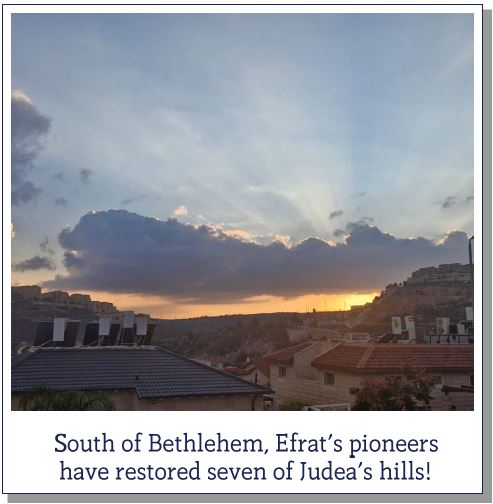
In the decade following the liberation of the Biblical Heartland during the Six Day War in 1967, a group of pioneers led by Chairman of the Judean Hills Development Company, Moshe Moskowitz and prominent Rabbi Shlomo Riskin embarked on a mission to establish a Jewish community just south of Bethlehem. Adopting the ancient city’s Biblical title, they chose “Efrat” as the name for the community they envisioned. Helping in the effort to found Efrat were students of a yeshiva, a Bible academy for young men, all of whom were driven by an unbreakable love for God, the Bible and the Land of Israel.
In August of 1980, the very first seeds for Efrat’s founding were planted with a groundbreaking ceremony at the yeshiva’s new permanent location. Yearning to fulfill the prophetic vision of restored and repopulated Judean hills after centuries of lying in ruins, their unwavering resolve bore fruit, paving the way, on the eve of Passover in 1983, for the community’s first dozen or so families to move into prefabricated homes near the yeshiva. Like the students who preceded them, Efrat’s first families were undeterred by the lack of infrastructure, electricity and running water. They remained focused on the greater mission to create a strong foundation for a new, prosperous community on the northern edges of Judea.
Over the next few decades, hundreds of likeminded pioneering families moved to Efrat, a community now comprising over 13,000 residents as well as seven neighborhoods, each of which is built on its own hilltop and named after one of the seven delineated species of the Land of Israel (Deuteronomy 8:8). With its growth, Efrat has developed into a regional hub for religious study, academia and cultural enrichment programming.
Adopting the ancient city’s Biblical title, they chose “Efrat” as the name for the community they envisioned.
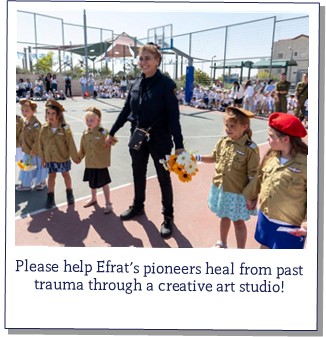
This past year, the community of Efrat launched an initiative designed to help former reservists, teens and young adults heal from past emotional wounds and trauma through various forms of art including ceramics, drawing, music and mixed media. Many have already started the healing process in sessions led by certified therapists at Efrat’s Mental Health & Resilience Center. To expand the program’s treatment, the community and mental health center need your support to construct and furnish a fully functioning creative arts studio that will serve all the patients in the program. Please help the devoted pioneers of Efrat bring healing and restoration for these precious souls! Your donation today will help them grow past trauma and walk into a bright future.