
By: Sondra Baras
Today is the Nachsa, Arabic for defeat, the day that the Arabs mark their massive defeat in their attempt to destroy Israel in 1967. A defeat that led to Israel’s liberation of Judea, Samaria and Jerusalem. For weeks now, the Arabs of Gaza have been attacking Israel, beginning with Israel’s Independence Day and the move of the US Embassy to Jerusalem, and continuing on and off in various forms — storming the fence between Gaza and Israel, missile and artillery attacks and now fire. But as they mark their defeat, their attacks have stepped up.
The Negev is burning! Arab terrorists of Gaza are sending burning kites across the fence where they are landing in rich agricultural fields, with crops nearly ready for harvest, or in nature reserves and forests. Millions of shekels worth of produce have been destroyed. Natural forests have been severely damaged. And the fires keep burning. Fire-fighting crews are running from site to site, putting out the fires as quickly as they can before they spread to inhabited areas. We hope and pray that no one will be injured or murdered by these fires.
About 75% of the kites are shot down before they can reach their targets and cause terrible damage. But think for a moment about what that sentence means. Kites are supposed to be for children. I remember the excitement I felt when my parents first gave me the string of a kite to hold, the wonder in my eyes as I looked up and saw my kite fly higher and higher, the frustration when the wind died down and the kite flopped on the ground. That is what kite-flying is about. And yet, the Gazans have turned kite flying into terrorism. They are teaching their children to turn their kites into incendiary bombs, meant for killing, destroying and maiming. Can you imagine shooting down a kite? But for a society that has hidden behind schools, hospitals and children for years, as it continues to fire missiles, rockets and artillery at schools and families in Israel, this is just par for the course.
But even as the rockets fell on southern Israel last weekend and the fire kites continued to strike and burn the fields today, we thank G-d that there has been no loss of life. We felt His protection over us as a rocket fell in a pre-school yard just minutes before the children arrived for school so that no one was hurt. But the children — those poor children who are frightened, whose sleep is constantly interrupted by sirens and dashes to the shelter. May G-d protect the children, keep them safe and calm their fears.
But there was good news today as well. Four months ago, MK Rabbi Yehuda Glick started a wonderful new project, in cooperation with Rabbi Tuly Weisz of Israel 365 and the Schindler Society —monthly Bible Study sessions in the Knesset where Christians are invited to listen and learn from Jews as they teach the Bible.
Today, I was privileged to have been invited to teach during today’s Knesset Bible session and it was truly a thrill. The subject was the anniversary of the Six Day War and each of the speakers selected something from the Bible to teach that had some connection to that war. As the Arabs mark this same date with burning kites against Israel, Christians and Jews marked the date with Bible Study. Here’s to that amazing difference!
In the Torah portion for this past week and for the coming Shabbat, we read of the steady deterioration of the nation as they suffer from a skewed perspective. Moses, as the nation prepares to move on to Israel, calls out to G-d: “Rise up O G-d and disperse your enemies” (Numbers 10:35) but in the very next verse, as Chapter 11 opens, we read of the nation who complains, who can only see the bad. Moses and the nation are perceiving the very same reality but their perception is so different. That same difference in perception characterizes the difference between Caleb and Joshua and the 10 spies as they return to the Nation a few chapters later. Caleb says: “We can go up” while the others say: “We cannot go up.” (Numbers 13:30-31)
I shared this thought in the Knesset today in order to illuminate the varying perspectives regarding the settlement movement. There have always been those who have said we can’t do it. That we will never succeed. And then there have been those who knew we could and did.
Over 42 years ago, a group of idealistic pioneers tried to settle in Samaria for the 8th time. After 7 disappointments, the government gave them permission to settle 30 families in a nearby army camp. And the community of Kedumim was born. Responding to the news, the crowd that had gathered in nearby Sebastia cheered, danced and praised G-d. They raised up the two rabbis who had led them in this effort — Rabbis Moshe Levinger and Hanan Porat, carrying them on their shoulders as they sang and danced.
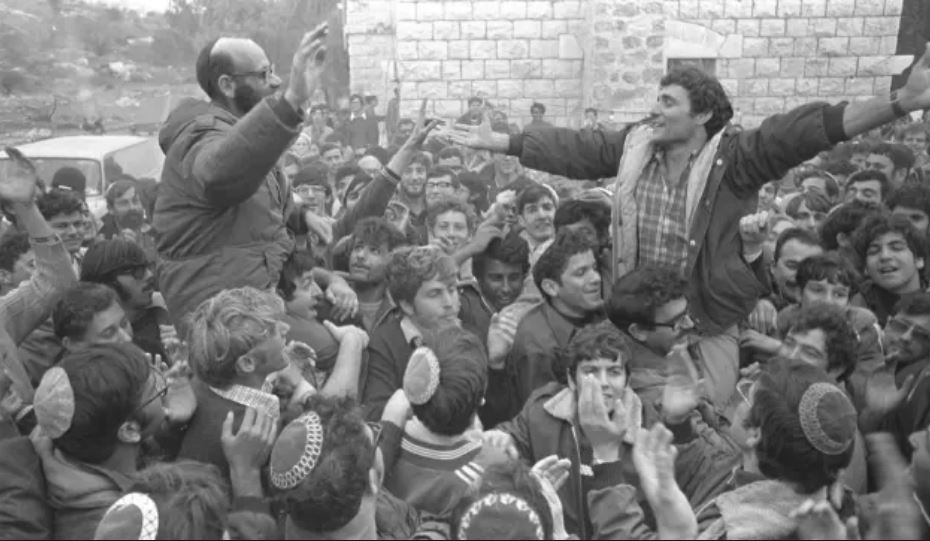
Celebrating the birth of Kedumim in Sebastia, with Rabbis Moshe Levinger and Hanan Porat
They could have complained bitterly about having to settle in an army camp. They could have given up. But instead, they had faith. They knew they could do it. They knew this was the beginning of a monumental movement to settle Samaria. And they were right. Today, there are hundreds of thousands of Jews living in Samaria and close to half a million throughout Judea and Samaria. They were right because they heeded Moses’ call to G-d to disperse the enemies. They were right because they heeded Caleb’s call: “Let us go up for we can do it!”