
Something significant is happening in Europe, and it deserves a serious conversation.
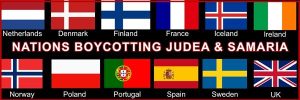
On September 22, the Netherlands is scheduled to begin prohibiting the import, purchase, and sale of goods originating from Israeli communities in Judea and Samaria. The Dutch government says the measure is intended to ensure that the Netherlands does not contribute economically to what it considers an illegal arrangement under international law.
And the Netherlands is not alone.
In a joint statement on September 8, Canada, Denmark, Finland, France, Iceland, Ireland, Norway, Poland, Portugal, Spain, Sweden, and the United Kingdom announced their intentions to introduce national restrictions, support European restrictions, or actively consider measures restricting trade from Israeli communities and entities in the Biblical Heartland. Their statement specifically cited “settlement expansion,” “settler violence,” and the publication of tenders in the E1 area east of Jerusalem as “undermining the possibility of a two-state solution.”
This is not an entirely new phenomenon. For years, European governments have, through product labeling and other measures, treated Israeli communities in Judea and Samaria differently from the rest of Israel.
But we should all consider what happens to the employees of businesses targeted by international boycott campaigns.
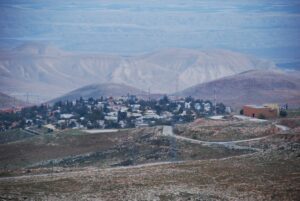
SodaStream, a company that manufactures appliances and devices that turn tap water into carbonated soft drinks, operated a major factory for many years in Mishor Adumim, near the Israeli city of Maale Adumim, just east of Jerusalem and E1. Hundreds of Arabs and Jews from Judea and Samaria worked at the factory. Following intense international pressure and boycotts, the company moved its principal manufacturing operation to the Negev, leaving approximately 500 Arab employees suddenly jobless.
The central point must be emphasized: When a workplace is sanctioned and boycotted, the livelihoods of its employees, regardless of their ethnicity, are also inevitably put at risk.
As SodaStream demonstrated, these workers are often Arab residents of Judea and Samaria. Arabs employed by Israeli businesses in the Biblical Heartland could therefore be among those most directly affected by international trade restrictions. If they lose their jobs, their incomes, and consequently the welfare of their families, are affected as well. An already financially constrained Palestinian Authority could also face additional pressure as the number of unemployed Arabs in Judea and Samaria increases.
If the stated objective is to improve Arab lives and advance peace, then the question to be asked should not simply be, “Does this hurt Israeli businesses?”
Rather, we should ask: “At the end of the day, who is being helped, and who is being hurt?”
Many Western governments, together with much of the international community, are enacting political and economic measures against Israeli communities and businesses in the Biblical Heartland. Israel has every right to examine the consequences of those policies and to respond through diplomatic measures, legal arguments, economic policy, or a broader reassessment of Israeli cooperation on joint governmental initiatives in Judea and Samaria and elsewhere. Any Israeli response, however, should be carefully designed and thoughtfully considered.
At the heart of this debate is a fundamental disagreement between Israel and much of the international community over how to view Judea and Samaria.
Many Western governments maintain that the presence of Israeli communities in Judea and Samaria contravenes international law and that Israeli economic activity in those regions therefore facilitates an “illegal” enterprise. Israel, along with countless friends and supporters around the world, has firmly rejected this assertion, viewing the most recent trade measures against Israeli communities and businesses in the Biblical Heartland as unjust and counterproductive.
At the same time, Israel must do more than simply issue condemnations. It should also present a serious alternative, one that unequivocally creates conditions in which Israelis and Arabs in Judea and Samaria can live, work, and build a future together.
If a policy is being justified in the name of peace, then we should ask whether it is actually advancing mutual cooperation.
For us at CFOIC Heartland, the answer to these new trade embargoes is a clear and unequivocal “no.” But how we can best play our role in offering another path forward in response is a question that has yet to be fully determined.
Shmuel Junger
Executive Director | CFOIC Heartland
Linked below is a news article by Itamar Eichner with ynetnews that was posted Sept 27, 2026.
‘They were looking for West Bank goods’: Israelis face searches at Amsterdam’s Schiphol Airport