
Article written by Sondra Oster Baras for Christians for Israel New Zealand and published in their October/November 2026 Newsletter titled “ISRAEL & Christians Today: Understanding Israel and world events from a Biblical Perspective”
 As you read this article, we will have just completed our month-long autumn holiday season. The season begins with Rosh Hashana, the Jewish New Year, which is first mandated in the Bible, referred to there as a Day of Horn-Blowing (Numbers 29:1) with a specific date—the first day of the seventh month. To this day, we follow the Biblical calendar alongside the regular calendar, and the first day of the seventh month fell this year on 12 September. [The Biblical Calendar is a lunar calendar while our regular calendar is a solar one, which means that each year, the Biblical holidays fall on different dates on the regular calendar.]
On the tenth day of the seventh month, we mark the Day of Atonement, a day of fasting and soul-searching. (Numbers 29:7). And, finally on the 15th day of the month we celebrate the seven-day Feast of Tabernacles followed by the eighth and final day of celebration, known today as Simchat Torah—Rejoicing in the Torah. (Numbers 29:12-39)
But what do these holidays mean to us today, as Jews in the 21st century, and especially as Jews living in our beloved homeland Israel?
Biblical holidays are mostly marked by agricultural events and specific sacrifices. The first two holidays however, have no agricultural significance. Rosh Hashana is associated with horn blowing and Yom Kippur with fasting. Just these two details however, make it clear that the significance of these holidays is spiritual. We do not celebrate the ingathering of the harvest in any way. We blow horns and we fast.
Jewish tradition going back thousands of years, brought meaning and content to these days. We blow a ram’s horn on Rosh Hashana, the very same animal that miraculously appeared to Abraham as a substitute for the sacrifice of Isaac, his horns caught in the bushes.
The sounding of the shofar is both a wake-up call to us as a people and a wordless way of communicating with God. The shofar reminds us to return to God, to obey His commandments and repent of our sins. But it is also our call to God to hear us, our beckoning to God to forgive our sins and take mercy upon us.
As we remember the binding of Isaac, we ask God to remember the incredible faith and obedience of our first forefather Abraham, as he prepared to sacrifice his only son, the son that God assured him would be the heir to God’s promises for Abraham’s descendants to become a nation and inherit a land. Abraham couldn’t help but wonder what God expected of him. How could He command him to kill his son, running counter to every ethical principle that God stands for? How could He command him to destroy the only possibility for God’s promises to be fulfilled? And yet, despite the questions, and despite the horrific pain and tragedy of killing his only son, Abraham was willing to go forward. And the ram represents God’s acceptance of Abraham’s supreme faith even as it speaks volumes against the very concept of human sacrifice so common in the ancient pagan world.
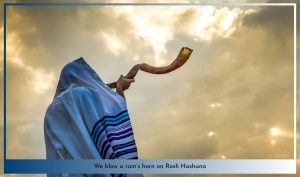 As we blow the shofar, we ask God to remember Abraham and forgive us our sins and enable that same original promise to go forward. The promise is an eternal one and we, Abraham’s children, are taking part in the fulfillment of that promise. As we continue to bear children and raise them in faith, as we teach our children the Bible and urge them to follow God’s commandments, as we settle and develop the land that God first promised to Abraham, and as we strive to create a kind society in Israel dedicated to God’s word, we are intimately connected to that original ram’s horn and to the shofar.
Rosh Hashana is the Day of Judgement. It is a day when we return to God and repent of our sins. It is a day when we stand in judgement before the Almighty and hope that He will forgive us and grant us a blessed New Year. But it is not a somber day. We spend many hours in the synagogue praying, but our prayers rejoice in God our King. We sing together as a congregation and after the services, we enjoy large family meals where we celebrate God’s blessings—our children, our homes, our health and our sustenance. We dip apple slices in honey to symbolize our hope for a sweet year. And we sing songs of praise together as a family.
Between Rosh Hashana and the Day of Atonement, Yom Kippur, we continue the process of repentance, with special emphasis on introspection, prayer and charity. On Yom Kippur we dress in white and fast for 25 hours, no food or drink entering our mouths. We spend many hours in the synagogue where we seek forgiveness, not only as individuals but as a nation. We read an ancient poem that describes Yom Kippur in the Temple, when the entire nation waited with bated breath for a sign that all was forgiven. Today, when we approach the end of the day, we pray together just as the gates of heaven are closing and our fate for the coming year is sealed. But at the close of the day, we know we are forgiven and we sing and rejoice in God’s goodness.
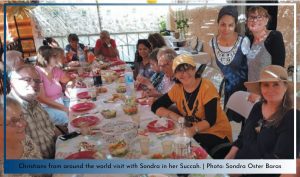
A quick meal to break the fast at home and then we are all outside our homes constructing the Succot, or the booths, that will become our temporary dwellings for the Feast of Tabernacles. And this is a joyous holiday indeed. Coming just four days after our forgiveness, we enjoy festive meals, hiking all over the country and a celebration of God’s bounty. In ancient times this was truly an agricultural festival. Even today, we mark the conclusion of the grape harvest at this time. But even in our modern-day world where we get our produce from a local supermarket wrapped in cellophane, we appreciate this time of year. The harvest is complete and the time for a new season is upon us. We pray for rain so that the new year’s crops will be plentiful.
Words cannot do justice to the incredible emotional and spiritual high that this season brings to us. The unique combination of serious introspection and repentance, with rejoicing in God’s goodness, would seem to be a recipe for an emotional roller-coaster. And yet, it fits in perfect harmony with who we are as a people, and to some extent, with who we are as human beings. Life is complicated and our spiritual centre is complex. We strive to be close to God even as we recognise our weaknesses and failings as human beings. And perhaps that is the greatest gift that God has given us—the ability to come close to Him and at the same time to understand our finiteness, to appreciate His all-present infinity while accepting our physical existence.
I have written often during these past three years of the odd combination in our daily lives of the stress of war and the constancy of ordinary life. And perhaps it is this combination of closeness to God and the physical reality of humanity that enables us to get through it all, perhaps even to thrive. Even as we fear for our physical safety, even as we cope with the consequences of prolonged war and our young men’s frequent forays to the battlefield, we know that God is with us, that He will continue to keep His promises to us. “The Eternal One of Israel will neither lie nor relent: for He is not a man that He should change His mind.” (I Samuel 15:29) He is eternal and He will not rescind His promises to the Nation of Israel. There is a parallel modern phrase that is often sung as a statement of faith in Israel: “The Eternal Nation does not fear a long road.” It may take a long time, we may suffer along the way, but we know that God will keep His promises to us and that we will prevail. Am Yisrael Chai! The Nation of Israel Lives!
Sondra Oster Baras
International President | CFOIC Heartland